Thursday, September 6, 2012

#394 - Marble Madness


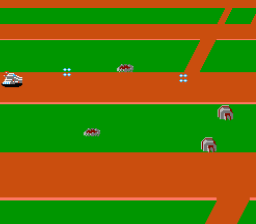
"And here comes the black ball from the top and WHAM! Blue is off the field, with red narrowly avoiding destruction! What MADNESS have we just witnessed!"


The cartoonish clown circles really add a disturbing flair to this humble game of marbles.

Marble Madnessis all about controlling a marble as it rolls down and around six whimsically designed courses. You'd be forgiven for thinking that sounds about as enthralling as watching a musical entitled "Boredom on Ice!" but the game succeeds as well as it can with the simple concept. The first three courses are almost as easy as rolling a ball down a hill. Navigate the marble around a variety of obstacles, like little moving acid pools or worms that have an gastro-affinity for marbles. While you have unlimited lives, your greatest asset is time. You have a set-time for each level – usually between 30-45 seconds – but after you finish a level, however much time you have left over goes into the set-time for the next level. Believe me, you will need as much time as you can for the last three levels. Level four is an aerial level, one that throws your marble hither and yon on the course. It's easy to lose control on level four, but level five is a different beast all together, defying the laws of physics and enabling you to go up easier than you can go down. Level six is the "ultimate" stage, and while I've seen an intimidating screenshot of it, I can honestly say I've never been here. And that's it. You can play game B, which is essentially a different (harder) control scheme or against another player, with both marbles racing to get to the finish line first. Both options add life to an incredibly short game, and indeed, the latter is Marble Madness' greatest flaw. Had the game included a few more courses – perhaps unlockable when you finish the game – it would have been perfect. Still, it's surprising that controlling a marble on a decline on your NES is as much fun as it is. Worth a roll.


B

#393 - Mappy-Land


              How did a mouse become a police officer in a land overrun with evil cats?


            There are almost always four ascending floors like this in each stage. 


Mice running away from cats, collecting wedding rings and baseballs, jumping on trampolines (don't let them turn red and break!) - these are but some of the quirky things happening in Mappy-Land. Mappy the Mouse (hey! That's you!) runs through eight colorfully themed stages, collecting items and avoiding cats, birds, and other creatures that want a piece of your feisty mouse body. The cats are your main enemies and they are ruthless. The second they see you, they will come for you. Luckily, almost every stage layout is designed to have four floors, thus giving you some room to avoid the cats. To explain further, let's say the cats are on the fourth floor, close to the top of the stage. Mappy is at the bottom floor. He is still able to see them, but he can collect his cheese, and go about his merry way, while the cats try to make their way down to him. Trampolines and ladders are how you and your enemies get from one floor to the next, but be careful on the tramps. The controls are a little sludgy to begin with, and on the tramps, it can be difficult to jump onto the right level. There are little weapons in each stage that you can use to get rid of or distract the cats, but they're usually more trouble to acquire than they're worth, especially on the earlier stages. Once you beat all eight stages and fulfill your girlfriend/wife/whatever Mapico's desires, you start the stages all over again, this time with a new item to collect. The stages repeat three different times, though the layouts change slightly and become harder the more you progress (the cats, in particular, are faster than you by stage 3-1). Cumbersome controls and repeating stages aside, Mappy-Land is an enjoyable quickie, a ten-minute blast of pure pick-up-and-play arcade quirk.


B

Tuesday, September 4, 2012

#392 - Maniac Mansion


                                           I think this cover speaks for itself.


                                                        At least he's honest.

I'm all for blowing up hamsters, but could you kids turn down that damn radio?! Maniac Mansion has always stood out from other point-and-click adventure games because of its weirdness (it is actually possible to blow up a hamster), but it succeeds because of its humor and the variety of things to do. Dave's cheerleader girlfriend Sandy has been kidnapped by the evil Dr. Fred, and only Dave and his hipster friends can bring Fred and his family of freaks to Funkytown a.k.a. Justice. While the story is disposable, the atmosphere/dialogue gleefully combines 80s horror movie teenage stereotypes, with 50s-era demented scientists. Each character – there are six, in addition to Dave – has a unique skill set, and since you can only bring two additional characters along with you, the replay value is off the charts; ten different endings, depending on who your supporting characters are and who does or doesn't die within the game. I grew up playing Maniac Mansion on an Apple computer, so it was a little hard for me to transition to using the D-pad for a cursor, as opposed to a mouse. There are certainly enough options within the game (Push, Pull, Use, Get, Turn On, Turn Off, it goes on) that dragging the cursor with the D-pad can be a burden at times, but the game is fun enough that most people won't mind it. Get down with the sickness ooo-waa-aaa-aaa (mind the corpse in the bathtub) and play this demented adventure game.


B+

Monday, September 3, 2012

Huzzah! The Quest is 50% Complete!


As of review #384, I am officially 50% done with this quest. I don't feel the need to make a big to-do about it, but I would like to offer some (hopefully) helpful advice to those who feel they may want to review an entire system's library, or perhaps, gaming bloggers as a whole.

  • Love to write. Loving gaming isn't enough. You have to have a passion for the written word.
 
  • Be yourself in your writing. I don't often review games in the traditional format (laying out my take on the graphics, music, controls, gameplay, etc)  because I've been reading those types of reviews since I was a kid and I'm tired of them. There's nothing wrong with that style, but I personally wouldn't have lasted this long if I would have kept myself to that "formula."
 
  • Write for yourself, not for ad money or page-views. It's fine if you want to get a following, but too often I see bloggers try to self-promote at the expense of actually putting out new material. 
 
  • Post frequently. Posting every day is the obvious ideal, but life gets in the way far too frequently to demand something like that of yourself. Three times a week is solid and do-able, in my opinion. This isn't just for the sake of keeping readers. This is so you'll stay committed and interested in your goal. And if you do miss a week (or two), don't beat yourself up or feel like you have to explain yourself to anyone. Just keep writing.


Only 378 more games to go, friends. Thanks for sharing this quest with me.

Cheers,

Dylan


#391 - Major League Baseball


               "Enteractive" you say? This purposeful misspelling intrigues me.


 I've always thought that mauve would really make baseball players' outfits sparkle.

There are approximately fifty trillion baseball games for the NES, and I can say, with great conviction, that Major League Baseball is indeed one of them. It delivers exactly what it promises within the title: pick a Major League team and play baseball against another Major League team. In 1988, the Major League license was the main appeal for this game. No longer would NES players suffer by having to pit Team A against Team D. Now, in 2012, it seems silly playing with twenty-five-year-old statistics (in-game stats are from '87, just in case anyone's wondering if I can add). It also bears mentioning that, even though LJN got the Major League license, they didn't get the rights to player names. Giving the players fake names seems like the next logical step, but they decided that stats would be enough. Basically, you're playing with stats against stats, which felt strange to me. Sure, you could look up each stat from the game, and figure out which player it belonged to, but that's even creepier than playing with a nameless character. But it's all about how the game plays, right? There are three options to wet your whistle: a regular game (National League vs. National League, American League vs. American), an all-star game (National League vs. American League), and the World Series (the World fluffin' Series). Batting and pitching are solid, but playing defense is like watching dogs in a dog show: some of the players understand what they're supposed to be doing and some of them don't. Other than that, it's baseball. You like it or you don't. If you can work with the defense and overlook the fact that there are at least ten more interesting baseball games one can play on the NES, Major League Baseball might intrigue you.

C-

Sunday, September 2, 2012

#390 - Magmax


            Great cover for a disappointing game. Also, I could have used that shield.


                                      Magmax, ladies and gentleman, in all its glory.


I'll give just about any shmup a good grade if it can provide me with a decent challenge, fast speed, and some shuper shweet weapon/ship upgrades, but Magmax? Besides having an intolerably stupid name, Magmaxis slow, predominantly boring, and its four levels (only four?!) can be beaten all the way through in fifteen minutes or less. These four levels do repeat, but the layouts are uninteresting, and the enemies remain the same, so what's the point? That question is only slightly rhetorical. Magmax, while mediocre at best, does present some unique concepts. For example, the four levels are actually split up between an upper level/above ground and a lower level/below ground. Gray platforms will periodically pop up, informing you that you can ascend or descend. It's not necessary, to alternate between the upper and lower levels in order to beat the game, so in theory, you could play through the entire upper level for one playthrough, then descend to the bottom for the second playthrough. The lower level has harder enemies and more environmental obstacles to avoid – and obviously, the backgrounds fit the environment – but otherwise, shooting things that shoot at you is still your primary objective. Magmax's other creative, though poorly executed, idea is the ship attachments that transform you into a robot. You can collect these parts in either the upper or lower levels. The problem is that, once you transform, you are incredibly large and enemy projectiles can easily destroy your gathered robot parts. The entire goal of Magmaxis to transform your pathetic vessel into an overwhelming robot and terrorize the poorly designed locales. In reality, you might be a robot for thirty seconds before some restless vagabond blows up your legs and top half, and you're left puttering in your ship, shooting weak lasers in a sandy desert, and dreaming of a better shmup.


C-

Saturday, September 1, 2012

#389 - Magician


           Taxan Consumer Division? As opposed to their Military Division?


                                                         Super Magician Bros!

Every step you take in Magician feels like it could be your last. Should you cast the wrong spell in the wrong area, stop playing the game for more than five seconds, or even talk to a person who doesn't like your face, you're dead. And if you didn't save beforehand, you have to start at the beginning. The latter sounds like a no-brainer, but you only have fifteen saves for the entire game. Conserving your saves is essential, but if you've never played the game, you might not know where the best place is to save. Since Magicianis long and incredibly challenging, it goes without saying that, if you want to battle Abadon, the evil wizard who needs a good thrashing, an FAQ/old Nintendo Power is required.

So what's the thrust of Magician? Well, the controls, mostly. Get the hang of the controls, mixing and matching spells, and you might have a shot at getting out of the first town. To talk to people, you have to press 'Up' when they pass by. 'A' is for casting spells, 'B' is for using items, and to select a certain spell or item, you have to press 'Select' to scroll through it on your menu. Sounds easy enough, but the configuration takes some getting used to. It's also not fun trying to navigate between a lightning spell and a shield spell while fighting a particularly difficult enemy.

Magicianis unique, in that it combines the feel of a point-and-click adventure with an RPG. Talking to people, buying a ton of food (you have to keep an eye on your food and water, and if you get dehydrated or starve, you die – different from the health meter), using the correct item at the correct place, all gives a point-and-click feel, while casting spells and walking around towns reek of an ancient Western computer RPG. I admire Magicianfor its unique approach, but while I don't like to be coddled in my games, I'm also not a masochist. To me, the difficulty of Magician doesn't outweigh the reward one would get by beating it all the way through. If you like your games served with a side of crotch-crunch, then let Magicianbe your master. Just don't forget the safety word. *

C+


*PROTIP: The safety word is not actually a word. It's the Power button.